You have two quotes on your desk. One is for AI seats: a price per person per month, a rollout plan and a renewal date. The other is for a build: an engineering estimate, a team and a launch date. Each is presented to you as the whole decision, and each answers a different question from the one your profit and loss statement asks you to answer this year.
The question that moves your numbers is narrower: which layer of the system do you need to own? There is also a third quote you may not have asked for: a workflow product, built for one process and priced per conversation or action. Most companies of your size end up with a mix of all three, and the mix is the decision you are really making for the next three years.

Three Layers, Three Answers
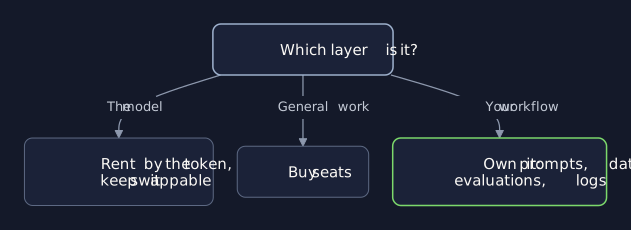
An AI system you rely on has three layers, and each one has its own right answer:
- The model. Rent it by the token, and keep it swappable as better ones arrive.
- Seats for general work. Drafting, search and notes for everyone: buy them.
- The workflow layer. Prompts, data, rules, evaluations and logs: own it.
The Three-Year View
Price every quote over three years, because their costs land in different places. Seats are operating cost that grows with headcount. A build is engineering up front, then the people who run it. Take a company of 600 staff that gives 250 people a seat and runs one document workflow: 20,000 documents a month, each 6,000 tokens in and 800 out.
| Line, over 3 years | Seats for 250 people | Workflow layer on rented models |
|---|---|---|
| Licences or usage | $270k, plus base licences | $720 to $72k in tokens |
| People | Admin and training time | About $1.17M for two engineers |
| Time to value | This month, for general work | The first workflow in production |
| Three-year total | About $270k, plus base licences | About $1.24M, before hosting |
| You hold at the end | A contract, renewed at their price | Code, prompts, evaluations, logs |
Two lines decide it. Tokens for a defined workflow are small, even at this volume. People are the large line: at the median software developer wage of $135,980 (BLS, May 2025), with wages at 70% of total pay, two engineers cost about $388k a year in salary and benefits alone (an all-industry benefits ratio), before the cost of recruiting and managing them.
That gives you the test a build must pass. Divide its yearly cost by the yearly volume: at 240,000 documents, that team must save over $1.60 a document just to cover its pay. Then name how the saving becomes cash: fewer hires, less overtime, or more orders through the same team. Set a payback date, an owner, and the result that would stop the pilot, and add in the cost of the work your team still does by hand while you wait for the first release to arrive.
Tokens Against Seats
A token is the unit model providers bill by, roughly three quarters of a word. That workflow uses 120 million tokens in and 16 million out each month, for one simple pass per document, with no retries or reasoning tokens. At list prices read in October 2026, it costs:
| Model tier, per month | Price per million, in / out | Monthly cost |
|---|---|---|
| Frontier models | $2 / $10 to $10 / $50 | $400 to $2,000 |
| Small models | $0.10 / $0.50 to $0.30 / $2.50 | $20 to $76 |
| Batch, for work that is not urgent | About half the list price | About half |
Seats price people; tokens and workflow products price work. A seat at $30 per user a month, paid yearly and on top of a base licence, costs the same whether someone opens it twice a month or all day. For broad, light use, seats win. For one process at volume, you manage the cost per item: with a product priced per conversation if one fits, or a workflow you own if not.
The Risks You Are Pricing
Each option moves risk rather than removing it. Lock-in means your prompts live inside one vendor's product, so leaving means building them again. Their roadmap sets when your feature arrives. And one engineer, yours or the vendor's, can hold the whole deployment in their head, then leave. Gartner predicts that by 2028, 70% of enterprises will abandon agentic AI built by a vendor's on-site engineers, "unable to evolve it on their own".
So whoever builds it, owning means three contract terms: the code and IP assigned to you, licences you can actually use, and a second person who can maintain it. Ask every option, in writing, where your data goes, how long it is kept, who can reach it and what is recorded, and compare the answers line by line before any of your data moves to their servers.
When To Buy, Build Or Both
- Buy a workflow product when one meets your volume, quality, controls and exit terms.
- Build the workflow layer when one process carries volume and no product fits it.
- Do neither yet when nobody can say what one item costs today, or who owns it.
- Buy seats when use is general, light and spread across many people.
First Steps
- Price every quote over three years. Put seats, usage, people and upkeep in one table, and add the cost of the work your team still does by hand while you wait.
- Name the one workflow that carries volume. Count the items each month and what one item costs today; that is the baseline any build, product or seat must beat.
- Ask the four data questions in writing. Send them to every vendor and to whoever would build it, then compare their written answers line by line, side by side.
Bring Both Quotes
A fifteen-minute call sets the three-year cost of your seat quote beside your build quote, and names the one layer worth owning. Sometimes the answer is to buy now and build later.
Where one workflow is worth owning, Engineering builds it on swappable models, with your prompts, evaluations and logs in your accounts and targets agreed in writing. Where every AI quote on your desk needs a second opinion, Advisory gives you one each month. For the ownership test behind all of this, read buy the commodity, build only what is yours.
References
- U.S. Bureau of Labor Statistics. Software Developers: Pay. Occupational Outlook Handbook, 2026.
- U.S. Bureau of Labor Statistics. Employer Costs for Employee Compensation, June 2026. 2026.
- Microsoft. Microsoft 365 Copilot Pricing. Read October 2026.
- OpenAI, Anthropic and Google. API pricing, Claude pricing and Gemini API pricing. Read October 2026.
- Gartner. Gartner Predicts 70% of Enterprises Will Abandon Agentic AI Built by Vendor Forward-Deployed Engineering by 2028. 2026.