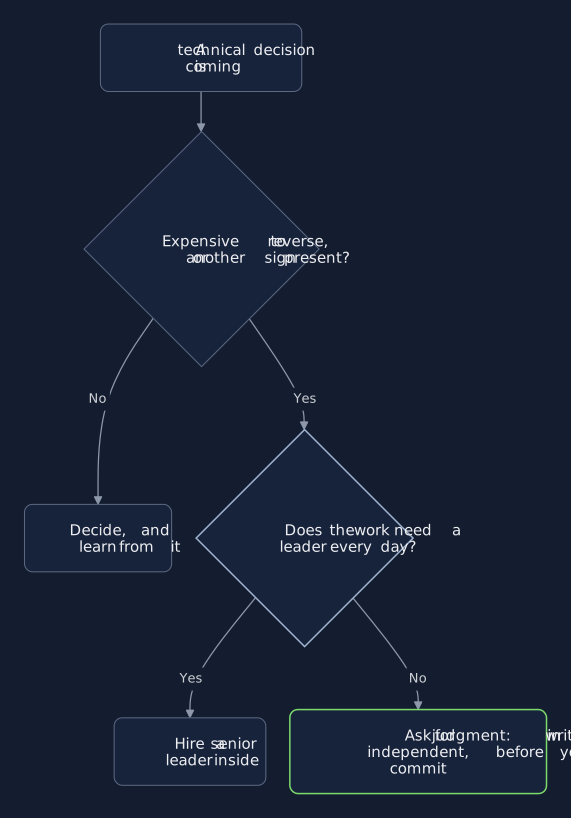
A vendor wants your signature on an AI module, and nobody on your team can judge the proposal. Your first thought may be to hire a chief technology officer. If decisions like that come three times a year and your team does not need a technical leader every day, a hire can be a full-time answer to a part-time need. The question is what to ask for instead.
You run a distribution company of three hundred people. This year you face three decisions. A vendor proposes an AI forecasting module. Your finance team wants to replace the invoicing system. Your board must approve an AI plan without knowing what it will cost or what could go wrong. Each one is expensive to undo, and nobody on your team has made one before.
In a 2025 survey of 966 mid-market firms in the US and Canada, a lack of in-house expertise was the top reason given for being unprepared to adopt generative AI, at 39%. Of the firms already using it, 70% said they needed outside support to get the most from their AI tools.

Why a hire often fits badly
Look at the job you would offer: a few hard weeks across a year, with long stretches of little to decide. In my judgment, that is a hard role to offer a strong senior leader. The ones I have seen do their best work with a team to lead and a steady flow of problems.
You need someone who has made these decisions before, at the moment each one is made.
Three signs you need senior judgment
- A decision is coming that is expensive to reverse. A platform, a contract that runs for years, the way your data is structured. If you can undo it next month at little cost, and no other sign applies, you do not need anyone senior for it; decide, and learn from it.
- You are buying technical work you cannot evaluate. A quote, a demo, a roadmap. If nobody on your side can say whether the estimate is reasonable or the design will hold, you are signing a contract without knowing what you are agreeing to.
- Your leaders ask questions nobody can answer in writing. What does it cost to run? What happens to customer data? Who stops it if it goes wrong? If the answers stay spoken and vague, your board approves a commitment it cannot see.
Five asks, each with its evidence
A title does not tell you whether the judgment is sound. Each ask below comes with the evidence you can demand, so you can check the answer without being an engineer yourself.
1. Judgment before you sign
The proposal, the quote and the roadmap are tested against your targets while the terms can still be changed. The evidence is a working test on your own systems, not a slide. For the forecasting module, that means the vendor's claims tested against your order history: which fields the module needs and whether you already hold them in usable form, its yearly running cost at your volume, and what a wrong forecast does to your orders.
2. Answers in writing
Your board gets one written page per decision: what it costs, what could go wrong, and who has the authority to stop it. You check it by how the page is written. Each answer states what it assumes, what it expects to happen and by what date, so you can compare the result with the page when that date comes, and see where the judgment was wrong.
3. Independence
The person reviewing a vendor's proposal should not be paid by that vendor, or by anyone who gains if you say yes. Ask for a written statement of what the reviewer gains from each answer. Apply it to everyone, me included: I gain if you decide you need outside judgment, because that is the service I offer. Weigh what you read here with that in mind.
4. Systems built and run
Ask for someone who has built and run systems like yours, and ask what they built and what broke: the failure, how it was found, the fix. A runbook they are cleared to show you, clear enough for someone else to rebuild that system, says more than a description.
5. Answers when the decision needs them
Each of your three decisions gets a date. Ask for a dated schedule agreed at the start: when each written answer arrives, and how many days you have to question it before anyone signs.
Your other two decisions
The invoicing system. Replacing it is weighed against fixing it, with the risk stated: which invoices could go out late or wrong during the change, and who would notice. The evidence: a list of the invoice types the change touches, each with the person who checks it.
The board's AI plan. It comes back as the written page described above, with each figure tied to an assumption your board can check against results on a stated date.
When a full-time hire is right
Hire when the work needs a leader every day: technology is your product, engineers need leading, and decisions come every week. That role belongs inside your company.
First steps this week
- List the decisions. The technical ones due in the next two quarters.
- Mark the hard ones. Expensive to reverse, or beyond anyone inside to judge.
- Take the first one marked. Before anyone signs, ask who inside can judge it.
In step 2, mark too any decision your leaders cannot get answered in writing. When you ask who can judge the first one, ask by what date. If a few decisions are marked and your team needs no daily technical leader, you need judgment at those moments, not a hire.
References
- RSM US LLP. Middle Market Firms Rapidly Embracing Generative AI, But Expertise Gaps Pose Risks: RSM 2025 AI Survey. News release, 2025-06-11 (n=966).