THE BRIEF
Define finished first
Before you pay per task, write what finished means for one contract and check that your systems can count every finished item, so you never pay for attempts.
Your three steps this week
- Pick the one contract whose output is easiest to count this quarter.
- Define finished: accepted, then no rejection or correction in a set window.
- Check your systems can count those items; if not, build that count first.
Sources
Download the brief for your team (PDF)For decades you have paid for software by the seat and for services by the hour. Now software does part of the work. Over the next three years, expect more of what you buy to be finished work, priced per task, from smaller teams. Not in every function and not all at once, but the direction is already visible, and buying it well depends on counting finished work.

Five repricings since the 1990s
The details of the next three years cannot be seen. The pattern can, because business technology has repriced itself five times since the 1990s. Each time, one input to the work got less expensive or easier to rent, and companies reorganized around it:
- Offshore outsourcing. The same work, done by hours bought at a lower rate.
- Software as a service. You rented software instead, per seat, per month.
- Cloud. You stopped buying servers and rented computing, paid by use.
- Robotic process automation. Bots that copied the clicks people made on screens.
- Language models. Machine reading and writing, rented by use, since late 2022.
In my read, the first three taught one lesson three times: a lower unit price pays only if you measure the full cost. With outsourcing, that full cost includes the coordination hours around the work. With rented software, the seats nobody opens. With cloud, the use nobody tracks.
The bots taught the hardest lesson: automation fails when it is aimed at the wrong process or breaks on small changes. A 2016 industry estimate put the share of first bot projects that failed at as many as 30 to 50 percent, and its authors pointed to projects aimed at the wrong processes. The bots were often brittle too: change a screen and they broke.
Why this repricing reaches the work
The fifth era differs in two ways. First, the cost of using it is falling very fast. The AI Index measured the price of running models that reach the same benchmark score: it fell more than 280-fold in under two years, between November 2022 and October 2024.
Second, these models read and write, so they can handle some of the variation that broke the bots, such as an email phrased differently. You test how reliably on your own tasks. So this era does not only reprice software; it starts to reprice the work your people did around it.
Coase and the cost of buying
In 1937, Ronald Coase asked why firms exist. His answer: a company does a task in-house when coordinating it inside costs less than buying it. Buying has its own costs, called transaction costs: writing the specification, checking the result, accepting the handover.
Models can now help reduce those costs: a model can check every delivered item against the specification, where a person used to sample a few. The same models also make your own staff faster, so AI lowers both sides, and Coase's logic says to compare them task by task. My read is that the buying side falls faster for work whose output can be specified and checked, such as tickets, invoices and leads; where work is hard to specify, in-house can still win. You can test it on your own work: for the same accepted output and quality, compare the supplier's price plus your cost of specifying, checking and accepting it against your cost of doing and coordinating it in-house. Smaller teams and outcome pricing are expectations built on top of that logic, not proven results, and the early signals point that way.
Three signals, and the gap
The signals so far come from three places:
- Services. Large consulting and outsourcing firms announced job cuts in 2025 tied to the skills AI work needs, while hiring AI specialists, and one press report said some clients of one large outsourcer were pushing for 20 to 30 percent lower prices on new contracts.
- Software. Stocks fell sharply in early 2026 on the fear that agents would shrink the number of paid seats, and vendors began adding usage-based pricing.
- Jobs. A Stanford study found that employment for workers aged 22 to 25 in the most AI-exposed occupations now sits about 19 percent below the trend of their less-exposed peers; its authors say plainly that the finding is descriptive, not proof of cause.
The capability is arriving; the results mostly are not, yet. In a survey published in 2026, fewer than four in ten respondents said AI had contributed to their company's profit, essentially unchanged from the year before. One analyst forecast expects more than 40 percent of agent projects to be canceled by the end of 2027. The technology is ahead of the organizations using it, and the next three years are mostly about closing that gap.
Three expectations and their tests
Each expectation below names what would prove it wrong three years from now.
Pricing moves from seats and hours toward price per finished task. Expect more contracts for business software and services priced per resolved ticket, per processed invoice, per qualified lead. This fails if none of your largest suppliers offers a price per finished item.
A seat bill is predictable, which finance teams like. Per-task pricing turns that fixed cost into a variable one, which lowers your operating leverage: your profit swings less when your volume moves. If your monthly volume falls from 10,000 orders to 7,000, a seat bill stays where it was; with no minimum fee, a per-task bill falls 30 percent with it. In a growth year it climbs with every task, so set a monthly cap; above it, work waits for a person's approval.
The teams you buy from get smaller and more senior. Smaller teams do not guarantee a lower bill: the saving reaches you only if the per-task price, plus your cost of specifying, checking and accepting, is below what a finished item costs you today; rebid it at renewal. This fails if teams delivering comparable work are no smaller and no more senior.
Customers and auditors ask for a log of what each agent did. If you sell to or operate in Europe, the AI Act's rules for high-risk uses, such as hiring or credit decisions, now start on 2 December 2027, and the regulation requires those systems to record events in automatic logs, which providers must keep for six months or more. Within three years, expect that request to be as routine as an uptime report is now. The log has to be built in; it cannot be rebuilt afterwards. This fails if your customers and auditors still do not ask for those logs.
Define finished first
The hard part of per-task pricing is technical: who decides what counts as one task done. A lead that sales rejects within a week was not qualified. So each item needs an identifier, a dated acceptance, and any later rejection or correction recorded against that identifier, so your system can subtract it. Without that, per-task pricing pays for attempts. The episode Why finished jobs wait days for an invoice defined done; here, it sets what you pay.
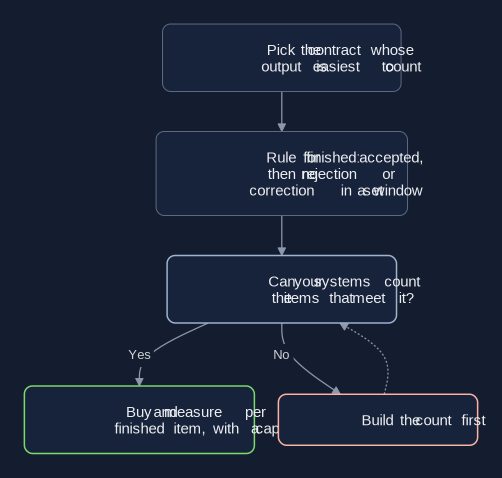
Set each window from how long a defect in that kind of task takes to surface, and add a rule for defects found after that window closes. Write the rule before the contract arrives, because a supplier's definition of done may differ from the one your team needs.
Waiting has a price too
Waiting to change contracts is reasonable; waiting to find out whether you can count finished work is not. Treat building that count as what finance calls a real option: you pay a little now for the right to switch later, and switch only when the measured result supports it. The premium is the engineering time to build the count, and it pays back after you switch if the charges you no longer dispute and the checking you no longer do are worth more than it cost.
Where to start this quarter
- Pick the contract whose output is easiest to count. One contract is enough to start.
- Write its rule for finished. Accepted, then unchanged for a set window.
- Check your systems can count those items. If not, build that count first.
Three questions are left for later episodes: who pays when an agent gets a task wrong, who becomes senior when agents do the junior work, and what survives if the AI market corrects.
References
- EY. Get ready for robots. 2016.
- Stanford HAI. AI Index Report 2025. 2025.
- Coase, R. H. The Nature of the Firm. Economica 4(16), 386-405, 1937.
- Cohan, P. Forbes column on the early-2026 software sell-off. Forbes, 2026-02-06.
- Brynjolfsson, E., Chandar, B., & Chen, R. Canaries in the Coal Mine? Stanford Digital Economy Lab, revised 2026-08-12.
- McKinsey. The State of AI in 2026. 2026.
- Gartner. Over 40 percent of agentic AI projects will be canceled by end of 2027. 2025-06-25.
- Gibson Dunn. EU AI Act Omnibus agreement. 2026.
- European Union. Regulation (EU) 2024/1689 (Artificial Intelligence Act), Articles 12 and 19. 2024.