The industry has a name for this mistake now. The agentic top ten (OWASP, 2025) lists "Excessive Agency" as a primary risk and breaks it into three ingredients: too much functionality, too many permissions, too much autonomy. Each one is granted at design time, by someone optimizing for a demo, in a meeting that nobody can remember.
The cost of that grant is not a bad answer. It is an action nobody can take back. A wrong summary is an annoyance the user corrects in a second; a wrong order is money gone, and no eloquent post-hoc explanation brings it back. Irreversibility changes the price of being wrong, and it should change the architecture, not the wording of the prompt.
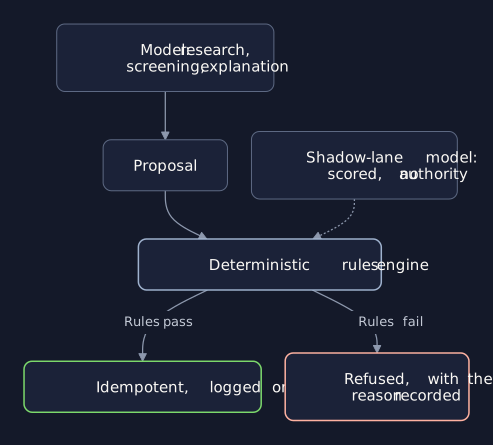
CVEST is the system ML LABS built on that principle: a non-custodial investing system of its own. The model drives the research, the screening, and the explanation. It does not place the order itself. Between it and anything that is permanent sits a rules engine that is deterministic, and that engine is the actual security model of the product.
Prove the model in a shadow lane first.
Draw The Line At Irreversibility
The line runs exactly where reversibility ends. Upstream of it the model earns its keep, and its occasional wrongness is cheap and correctable. At the irreversible step and past it, control passes to rule-driven code whose behavior is fixed, logged, and replayable.
The model proposes an action; a deterministic engine disposes, applying explicit rules that the model has no ability to bypass, override, or argue with.
Every consequential operation is idempotent, so the same logical request, if it is submitted twice, has the same effect as submitting it only once.
Custody stays with the customer. The system never holds funds, which puts a cap on the blast radius of any failure by construction rather than by policy.
This is the same instinct as gating irreversible actions behind explicit deterministic checkpoints (Anthropic, 2024). The point was never that the model is not to be trusted. The value of any checkpoint scales with the cost of whatever action sits behind it, and some actions cost too much to be left to inference by a model. Idempotency is where that principle becomes code. A network blip, a retry, a race: any of them can fire the same consequential step twice, and in a money system a duplicate is a loss. Idempotency keys for safe retries (Stripe) are the reference pattern. Building it in from the first commit costs almost nothing. Retrofitting it after the first double execution costs that double execution.
Determinism buys the other half of the guarantee. A rule-driven engine returns the same decision on the same inputs, which means a disputed order can be replayed: the inputs reconstructed, the rules re-applied, the outcome reproduced exactly. A probabilistic step in that path destroys the property, and with it the ability to answer the only question that matters after something goes wrong: why did the system do that?
AI-driven is a claim about the workflow. It is never an excuse for an order nobody can audit.
Ship ML In A Shadow Lane
There is real value in letting learned models improve the consequential logic over time. How you introduce them decides whether they turn out to be an upgrade or a liability, and the way you introduce them is a question of architecture, not of modeling.
CVEST runs a shadow lane. A candidate model executes alongside the deterministic path, its decisions recorded and scored against what actually happened, with zero authority to act on anything. It has to clear an explicit promotion gate first, and that gate has one bar: the model has to beat the deterministic rules on the history that is real.
That bar inverts the usual burden of proof. The rules are the incumbent here, and the challenger has to justify itself. It is not enough for a model to be newer, more sophisticated, or more impressive in a notebook: it earns live authority by out-performing the incumbent rules on recorded outcomes, or it stays in the shadow lane indefinitely.
The design also yields a continuously accumulating record of how a proposed model would have decided, against how the deterministic engine actually did. That record is the promotion evidence, and it exists whether or not anyone ever promotes anything. The same discipline governs agent-native systems where every mutation writes its own audit row: the log is not instrumentation bolted on afterward. It is the substrate.
When The Path Is The Deliverable
In regulated or fiduciary contexts, the requirement shifts from a good answer to an auditable path to it. A system that reaches the right decision through an inscrutable path is inadmissible. A less clever system whose every step is logged, ordered, and replayable is what the context demands. The rework is severe because auditability is not a layer. It is a property of where the boundary was drawn, and a boundary drawn in the wrong place cannot be patched; the flow has to come apart. The same failure mode shows up wherever terminal states and duplicate charges decide whether an inference pipeline can be trusted, which is a clinical system rather than a financial one and lands in the same place.
First Steps
Map every action in your system by reversibility, and draw a hard line — the model may live above it, and only deterministic code operates at or below it.
Give every operation that has consequences an explicit key for idempotency before you ship it, and not after a duplicate has taught you why it is needed.
Put any learned model in a shadow lane that logs decisions and a written promotion bar it must beat on real history, never with day-one authority over outcomes.
Draw The Boundary Before The Build
Keep the model where its fluency is a gift and its errors are cheap. Put a core that is deterministic and auditable between it and anything that is permanent. That is not a limitation that is imposed on the AI. It is the condition under which the AI becomes shippable in a domain where mistakes are not recoverable, and it is the same condition that every serious answer to the context an enterprise agent needs has to satisfy.
The boundary is the cheapest thing in the system to get right and the most expensive to move later. Drawing it is an architecture decision, and the first call is where it gets drawn: before build money is committed rather than during the incident. A boundary drawn on a whiteboard and a boundary that survives a storm of retries are not the same boundary.