Picture a firm of two hundred people that gave its account teams an AI tool to draft client reports; this is an illustration, not a client story. The business case counted the hours of drafting saved. It did not count the hours a team lead now spends each week reading every draft, checking the figures and rewriting the parts that are wrong. Those hours are real, they are not in anyone's plan, and they decide whether the tool saves more time than it takes.
You are probably paying for them already. A survey published in October 2026 asked 2,052 employed US adults who use AI at work weekly how they spend that time. Of them, 82.5% spend some time each week overseeing, checking or fixing AI's work. A news report on the same survey adds that 31.6% of respondents spend at least three hours a week on it.

The load lands on your managers
The same survey found 40.7% of managers spend at least three hours a week on AI oversight, against 25.0% of individual contributors. Among those who have trained an entry-level employee, 60.0% said getting good work from AI takes at least as much effort as training that person, and 33.1% said more. Another 40% said less, so the results are mixed.
The accounting is less mixed. Of the workers who spend any time managing AI, 61.8% say their employer does not fully account for that time, or they are not sure; for 34.5%, it is not counted at all. The figures are self-reported, from one survey of people who use AI weekly, so treat them as a reason to measure your own team, not as a measure of it.
The savings come after the investment
A new AI tool behaves less like software you switch on and more like a new hire. At first, someone has to set the standard, show it good examples, check nearly everything it produces and fix what it gets wrong. That upfront investment of your people's time can be larger than the business case assumed, and in the first weeks it can exceed the time the tool saves.
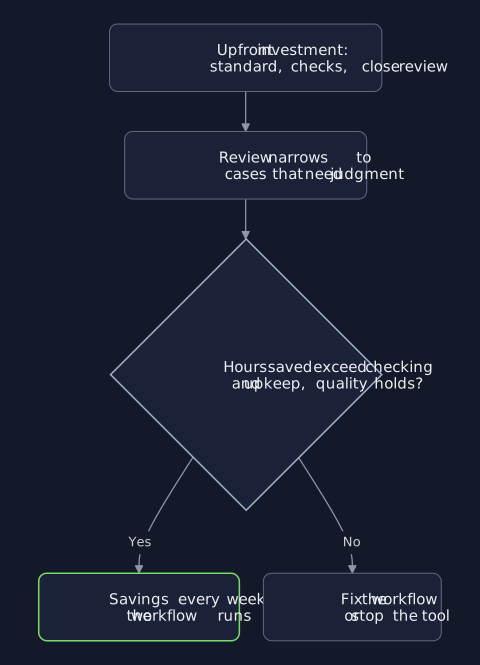
The savings come after. Once the standard is written down, the checks that a rule can do are built into the workflow, and a person reviews only the cases that need judgment, the checking time can fall well below the time saved. From then on the saved hours come back every week the workflow runs. They last as long as someone owns the checks, the quality holds, and the hours saved keep exceeding the hours spent checking and maintaining the tool. That is the trade: a larger investment up front, then savings that stay while you keep measuring them.
The risks, named
The trade only works if you watch three risks from the first week:
- The review load stays high. If checking and upkeep take more hours than the tool saves, the tool costs your people time. Set a review date before you start; if the hours saved do not exceed the hours spent by then, fix the workflow or stop the tool.
- Errors slip through. A tired or rushed reviewer can approve what looks right. Decide what a person must always check, and have someone sample the rest each week.
- Adoption stalls. When checking is invisible, people may do it after hours, skip it, or drop the tool. Count the time openly and measure both: use and checking.
Count the checking time
You cannot judge a tool by one side only. For each AI workflow, record three numbers:
- Hours spent checking and fixing each week, and who spends them.
- Errors found after review, the ones that reached a client or a ledger.
- Hours saved each week on the work the tool does for you.
Put the checking hours into workload plans, the same way you would plan time for training a new hire. A manager who spends three hours a week reviewing output has three fewer hours each week for coaching and running the team, and the plan should say so.
Build the checks into the work
One way to shrink the review load is to write the checks down and build them into the work. A figure that must match its source is compared automatically. A draft missing a required section is sent back before anyone reads it. Cases no rule settles reach a person with the reason they failed; that person also makes the required checks and samples what passed.
Those checks encode how your company works: which errors matter, who approves what, and what a correct report looks like for your clients. They are worth building in-house, with experienced engineers beside your team, so your people understand them and can change them as the work changes. Use outside models; own the standard and the checks.
When to wait
Until someone knows who checks a tool's output and how long it takes, add no new AI tools.
First steps this week
- Ask each team lead. How many weekly hours go to checking and fixing AI output?
- Pick the workflow with the most hours. Write down the standard its output must meet.
- Add the hours to the plan. Put them in next month's plan, beside the hours saved.
Bring your numbers
A fifteen-minute call goes through the workflow where your people spend the most time checking AI, and names the first check worth building into it. If the tool already gives back more hours than it costs your people, you hear that plainly, and you keep it as it is.
Where a workflow is core to your business, Engineering builds the checks and review queue with your team, so your people own them and keep the savings once review time falls. For a regular outside review of which AI tools earn their upkeep, Advisory gives you one.
References
- Founder Reports. Botsitting Report (2026). Founder Reports, published 2026-10-21.
- Stacker, for Founder Reports. Most workers say getting good work from AI takes as much effort as training a new hire. KESQ, published 2026-11-05.