AI now writes a growing share of your code, answers a growing share of your customers, and produces the analysis your decisions rest on. The output curve has never looked better. The question asked too late is what anyone in the company is learning meanwhile, because the first time the system must change, somebody must understand it well enough to change it.
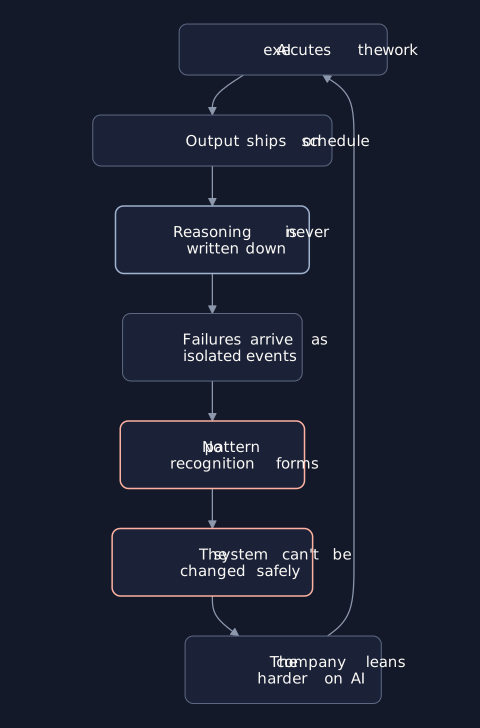
Nothing in the loop requires anyone to learn anything. The AI completes the task, the output ships, the next task arrives, and no step forces a human to understand why the work succeeded, what the system assumed, or how the decision will have to change when conditions move. Output accumulates. The knowledge that would let you adapt does not.
This is the failure mode ML LABS is paid to prevent. The practice runs an ongoing engineering retainer for HeartSciences, the medical-device company whose AI-ECG platform runs in clinical production, and ML LABS engineered the backend of that platform, which has reached clinical production in two countries and keeps expanding. Ownership of a live system is not an abstraction in that engagement. It is the work.
The bill arrives when something has to change.
Three Ways Context Walks Out
Three things leave the building when nothing retains them: the reasoning behind decisions, the shape of failures, and the substrate new people learn the system from.
Decision Provenance Disappears
The system picks a vendor, sets a price, or chooses a schema, and the output looks reasonable enough to ship. Nothing records what it assumed or what it discarded. When a similar decision returns with different inputs, there is no earlier reasoning to compare against, so the prompt is re-run and the new answer inherits the same thin basis.
The decisions worth keeping are made at design time, which is when they are cheapest to make and easiest to lose. The AI-ECG platform was designed from the start so that onboarding a new healthcare organization is configuration rather than code: HL7 field mappings, enabled AI models, invoice pricing, storage provisioning. That property is not visible in any one file. It was a judgment made before the code existed, and judgments like that stop being enforced the moment nobody in the room remembers why they were made.
Failures Stop Aggregating
When failures are retried or routed singly, nobody sees them as a series. The pattern that would have forced a redesign becomes a steady dashboard line, mistaken for a baseline.
A hedge fund ML LABS worked with had been accumulating unnecessary and polluted data without anyone noticing: the aggregation mechanism was discarding information that mattered for training the fund's models, and the storage layer was duplicating what it kept. Correcting both cut storage costs by more than 60% and made their models 2% better. Nothing had ever alarmed, because nothing had been built to alarm on it. The full account of what ownership of a live system buys sits with the argument for ownership.
Onboarding Loses Its Substrate
People used to learn a system by inheriting its mess: how data behaves, where integrations break, what the last decisions optimized for. When execution runs end to end through an opaque layer, that substrate exists only in chat logs and outputs nobody keeps. Then the person who held it leaves. The workflow still runs. No human can explain it.
Go full AI without an owner and you end up with operations that work and an organization that cannot explain them.
The loop is self-reinforcing, which is why it is hard to see from inside it: the more of the operation the AI carries, the less that anyone needs to understand it on any given day, and the less that anyone understands it, the more the company depends on whatever the AI happens to be doing, including on the day that it stops being right.
What A Standing Owner Retains
A production AI system without an owner degrades in four directions at once. Models drift, costs creep, failures go silent, and the context walks out the door. The first three surface on a dashboard, if somebody built the dashboard. The fourth is invisible by construction, because what went missing is the person who could have told you what to watch.
The check on any of this is what the arrangement produces. Under its ongoing retainer with HeartSciences, ML LABS shipped their billing operations automation and multi-site clinical operations system, two production systems delivered by the practice already operating the platform beneath them. Billing cutover waits for 98%+ agreement with expert-adjudicated determinations, and the shadow phase before it exists to surface whether automation is the right move at all: more than 15–20% of records with missing critical fields means the source data, not the workflow, is the constraint. Both are the product of someone looking.
The mechanics that keep an owner honest are contractual rather than cultural. ML LABS writes measurable targets into the contract before the work starts, and the arrangement to operate what it built runs month to month and ends on 30 days' notice from either side. An owner who protects their position by keeping the reasoning inside their own head fails that test the first time a client applies it. Ownership that cannot be ended is not ownership.
Knowledge moves only when someone explains it.
First Steps
Name the decisions that earn a written rationale. Pricing, architecture, vendor selection, customer prioritization: record what was assumed and what was rejected, not what was chosen. The output is already stored; the reasoning is the part that evaporates.
Read the failures the AI absorbed. Pull the exceptions your systems retried, routed, or swallowed and look at them as a series rather than as incidents.
Put one accountable person on each production workflow. Not to do the work, but to be the one who can explain how it works, what it depends on, and what would have to change if the inputs shifted. If no name comes to mind, that is the finding.
One Owner, Written Reasoning
Treat learning as a deliverable of the AI work rather than a by-product. Capture the reasoning behind consequential decisions, aggregate the failures the system is absorbing, and make one person accountable for the operating model of each workflow.
Where the operation already runs on AI and nobody inside can explain how it works, the missing piece is an owner, and Advisory is the standing version of one: hands-off monitoring, a standing review of cost and drift, an audit trail kept intact, and Engineering is called in when the answer is code. The test of that arrangement is whether your organization can explain the system it depends on without having to pick up the phone.