THE BRIEF
Records over slides
Before you hire an AI firm, have it show you, on a live system, the record that answers the objection your board raises first; if all it can show is slides, you have your answer.
Your three steps this week
- Ask your board which of the five objections it raises first.
- Ask each supplier for the record that answers it, on a live system.
- Write that answer into the first release's goals, at a fixed fee.
Sources
- Why Your IT Project May Be Riskier (2011)
- Cost of a Data Breach Report (2025)
- MIT NANDA, The GenAI Divide (2025)
You are about to give an outside AI firm your data, your systems and part of your budget. Your board will raise five objections: the system makes things up, your data leaks, you could build it yourselves, a small firm may disappear, and the cost will overrun. Each objection is right until the firm you meet shows you the record that answers it, on a live system.

Why it matters to you now
The published evidence says most AI efforts disappoint. A study of generative AI pilots (MIT NANDA, 2025) found that most companies' pilots showed no measurable effect on their profit. It also found that tools bought from specialist firms or built with partners reached deployment about twice as often as tools that companies built on their own.
The study includes 52 interviews and a survey with 153 answers, so read it as a signal, not a law or a reason to hire. The real question is how you test the help an outside firm offers you.
1. Errors: where each one is stopped
These systems do make things up, and the mistakes have already cost real money. A report delivered to a paying client shipped with citations to studies that do not exist and a quote its source never contained, and the firm refunded part of its fee to that client.
Any AI model produces some wrong answers, so do not ask whether a firm's system ever makes errors. Ask instead where each error gets stopped, and by which step. A well-built AI system catches errors in three layers, each one aimed at a different kind of error:
- Every fact points to its record. A reader checks it against the source in one click.
- Plain code computes every number. The model never writes a figure itself.
- A separate check reviews the work. A different process from the one that wrote it.
A claimed error rate without its test cases, scoring method and results is not something you can audit, and a demo on data the firm chose can be staged. So add your own control test: bring a case where the input says one figure and the source record says another, and watch which step flags the mismatch. Ask, too, what has slipped past all three layers.
2. Data: governed or ungoverned AI
Your data can leak, so make the supplier show you exactly what its systems can reach and what stops everything else. Your data may also already be entering tools nobody governs: in a breach study (Ponemon Institute, 2025), organizations with high levels of unapproved AI use paid about $670k more per breach on average than organizations with little or none of it. That is a correlation, not proof of cause, since a company with heavy unapproved use may be careless elsewhere. The sharper finding: of the organizations that reported a breach of their AI models or applications, 97% said they lacked proper AI access controls.
A ban on outside AI tools does not settle it: a ban is a policy, not an access control, and it does not show whether use continues. The choice is rarely AI against no AI, but AI that someone governs against AI that no one does. Governed looks like one page: every system the firm's AI agents can reach, what each agent may read or change, and under whose credentials. A firm that cannot write it for a system it already runs does not know the answers.
3. In-house: the shape of the team
Sometimes you should build it yourselves: when the system is core to how you compete and you can keep a senior team on it for years. Price what in-house really costs a company your size: hiring senior AI engineers, keeping them once they are trained and in demand, and the months before your first release while the team forms and learns your systems.
When a project runs late, the usual response is to add more people. Brooks's law, a well-known rule in software engineering, says that adding people to a late software project makes it later. Part of the reason is plain arithmetic: every pair of people is a separate line of communication, so 3 people have 3 lines and 10 people have 45 lines. Each line can turn into a meeting, a handoff or a misunderstanding, in your own team or in a supplier's.
The question is the team's shape, not who employs it: a few senior people holding the decisions, and checks that run on every change. Ask to watch those checks run on one recent change, and how many problems that system's users found that the checks missed. Whoever builds it, have its decisions, tests and documentation written into your repository as the work is done, so what a supplier learns stays with you after the supplier has gone.
4. Small firm: who holds accounts
A small firm can disappear, so test continuity, not promises. Check that you, not the supplier, hold the deployment accounts, the operating access and the credentials the system needs. A large firm can replace a lead who leaves, and that spare capacity is worth something. So in any firm, ask who will build the work and how long they will stay on it.
You carry key-person risk either way; ownership reduces it. Ask for every piece of custom work to be yours from the moment it is written, with its history, documentation and a runbook, the written steps to operate it. Then test the handover: when another engineer can deploy and run it from the repository and runbook alone, the supplier is replaceable.
5. Cost: the tail, not the average
A study of 1,471 IT projects (Flyvbjerg & Budzier, 2011) found an average cost overrun of 27%. One project in six overran its budget by 200% on average, and its schedule by almost 70%. Those were IT projects, not AI builds, but watch the tail: the rare, very large overrun.
Statisticians call this a fat-tailed distribution: rare outcomes so large that they dominate the total. You do not manage a fat tail by negotiating a better average; you limit how large any single loss can be. Break the work into small, separate releases, agree on each one's goal in writing before any work starts, and ask the supplier to fix the fee for each defined scope, so an overrun on that scope becomes the supplier's cost and not your own.
Some margin on a fixed fee is the price of moving that risk onto the supplier. Compare that margin with the tail you would otherwise keep: in that study, the one project in six in the tail roughly tripled its budget on average. Read exactly what the fixed fee excludes, because an overrun on excluded work is still your cost. An economist would call each release an option: you pay a small, known amount for the right, not the obligation, to continue, as long as the contract lets you stop after any release. A fixed fee cannot move your own cost of a delay, so keep each release small: a delay then costs you less and shows up sooner.
The record for each objection
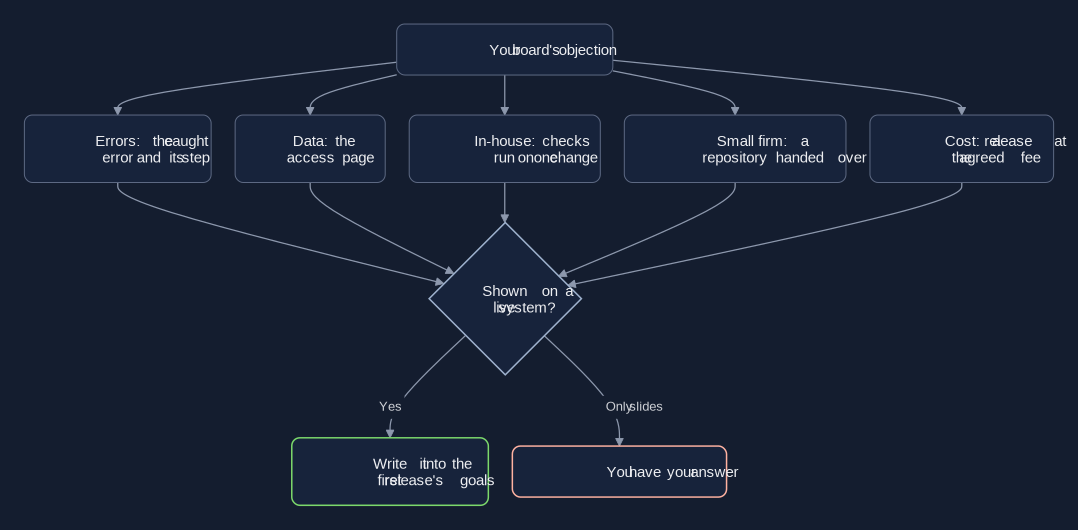
Start with the objection that could stop the approval; it is often the one your board raises first. Make its answer part of the first release's written goals, before work starts.
The rule is records over slides: before your next meeting with a supplier, take that objection and ask to see the record that answers it, on the firm's own systems or on a client's with permission and the data masked. If all it can show is slides, that is the answer.
References
- MIT NANDA. The GenAI Divide: State of AI in Business 2025, as reported by Fortune, 2025-08-18; interview and survey counts (52 interviews, 153 survey answers) per The Register, 2025-08-18.
- Ponemon Institute, for IBM. Cost of a Data Breach Report 2025. Released 2025-07-30.
- Brooks, F. P. The Mythical Man-Month: Essays on Software Engineering, chapter 2. Addison-Wesley, 1975.
- Flyvbjerg, B., & Budzier, A. Why Your IT Project May Be Riskier Than You Think. Harvard Business Review, September 2011.