Your new AI workflow was designed by people who have never run the process, and the people who run it saw it last. It breaks first on the exceptions: the cases your staff handle every week that no procedure describes. Your staff know those cases, and your system's history records most of them. A design built from the procedure alone misses both.

Why it matters to you now
A global survey of 40,500 workers in 36 countries, published in November 2026, compared workers whose employers involved them in reshaping their work in response to AI with those whose employers did not. Among those involved, 96% said they were willing to adapt; among those not involved, 29%. The figures are self-reported, and companies that involve their staff may differ in other ways too, so the survey shows an association, not a cause.
Willingness is the smaller reason. The bigger one is your investment. The people who run the process know how it really works, and they keep running it once it is live. Leave them out, and you pay to automate the procedure instead of the process, then pay again to fix it.
The procedure and the process differ
Your accounts payable team matches each supplier invoice to its purchase order and its delivery receipt. The procedure says: if all three agree within tolerance, approve. That three-way match is the case a design team automates. Your clerks also handle these:
- Freight on its own invoice. A supplier bills freight separately, with no order line to match.
- One order, three receipts. A partial delivery arrives as three receipts against one order.
- A price agreed on a call. The invoice has the new price; the order still shows the old one.
A workflow built from the procedure holds each of those for manual review with no reason, or rejects invoices you owe, and your clerks must then find the cause of each hold themselves.
Start with the event log
Interviews alone miss what people do without thinking about it, so start with the record. Your finance system logs most steps each invoice took, with a time stamp: received, matched, held, approved, paid. Process mining reads that event log and draws the paths your cases really followed, which the field's own manifesto calls the real process, as opposed to the assumed one. Each distinct path from first step to last is called a variant.
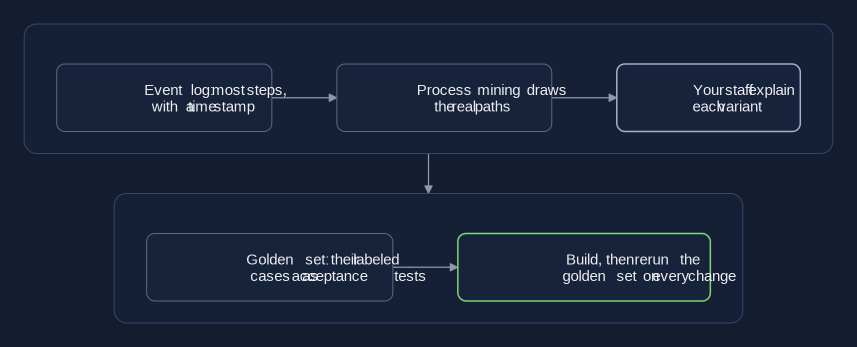
Ask for the variants ranked by how many cases followed each one. Expect the documented path to be one among several, and check whether it is even the most common. The log is also incomplete: steps your staff take by email or phone usually do not reach it. When a variant shows an invoice untouched for days and then approved, ask what happened in between. The answer may be a phone call to the supplier, and the design needs that step too.
Your staff explain each variant
Then the people who run the process explain the variants. Why did this invoice wait nine days before anyone approved it? Why do invoices from one supplier take a path no other supplier takes? Each answer becomes one of three things the design needs:
- A rule, such as matching freight to the delivery it belongs to.
- An exception path, such as holding an invoice for its last receipt.
- A data field, such as a record of the price agreed by phone.
The log tells you how often a path occurs and how long it takes. Your staff tell you why, and which variants are errors to remove rather than cases to automate.
To know the design works, test it on real cases. Your clerks pick past cases, the standard ones and the exceptions, and write down the right outcome for each, checked against your current payment rules. That set is called a golden set, and each case in it is an acceptance test. The workflow must pass it before launch, and every later change runs it again. Designers cannot write those outcomes alone; they need the people who decided those cases.
Your staff own the exceptions
Once the project team leaves, your clerks own the workflow. Cases it cannot settle go to an exception queue they work, and three choices decide whether the queue helps them:
- Every held case carries its reason. Name the failed check and the values that failed it.
- Every resolution is recorded. What the clerk did, so the next case can follow it.
- The queue is counted by reason. The largest reasons show what to design next.
Keep mining the log once the workflow is live. Process mining then compares the live log with the design and flags the logged cases that left the designed paths, which the manifesto calls conformance checking. Your clerks look at each new path first and decide which it is: an allowed path, a recording problem or a real exception. When it is a new exception, they add it to the golden set with its outcome checked against your rules, and whoever maintains the workflow makes a change that still passes every earlier case in the set.
That takes your best people's time, and you spend that time either way. An exception found in design gets built and budgeted. Found after launch, it means rework, manual handling, and often a spreadsheet your staff keep beside the new system to work around it.
When a design is not ready to build
A design is not ready until the people who run the process have signed off on its exception paths and labeled the golden set. If either is missing, fund the mining and the labeled cases first, then the build. Ask whoever proposes it to show you both before you approve anything.
Where to start, before anyone builds
- Pick the workflow. The one you are about to automate; export three months of its log.
- Have it mined into paths. Get every variant, ranked by how many cases followed it.
- Ask the two who handle most cases. Have them explain the five most surprising paths.
Their answers are the first page of the specification.
References
- The Adecco Group. Release on the 2026 Global Workforce of the Future report. Released 2026-11-19; 40,500 workers in 36 countries, surveyed June-July 2026.
- IEEE Task Force on Process Mining. Process Mining Manifesto. In Daniel, F., Barkaoui, K., & Dustdar, S. (eds.), BPM 2011 Workshops, Part 1, LNBIP 99, pp. 169-194. Springer, 2012.