ECG confirmation on HeartSciences' MyoVista Insights platform took 80% less time with the delivered workflow, and the final sign-off stays with the clinician. ML LABS engineered the platform's backend, a platform that has reached clinical production in two countries and keeps expanding. AIM Consulting built the frontend. The architecture and the technical decisions across infrastructure, AI inference, EHR integration, and security were for ML LABS to make and own.
The backend had to ingest studies from multiple device manufacturers, run AI inference across multiple model providers, participate bidirectionally in hospital clinical workflows over HL7 and FHIR, and satisfy medical-device regulatory requirements in two jurisdictions. Each of those is a seam, and each seam is a place where a clinical system can be wrong without saying so.
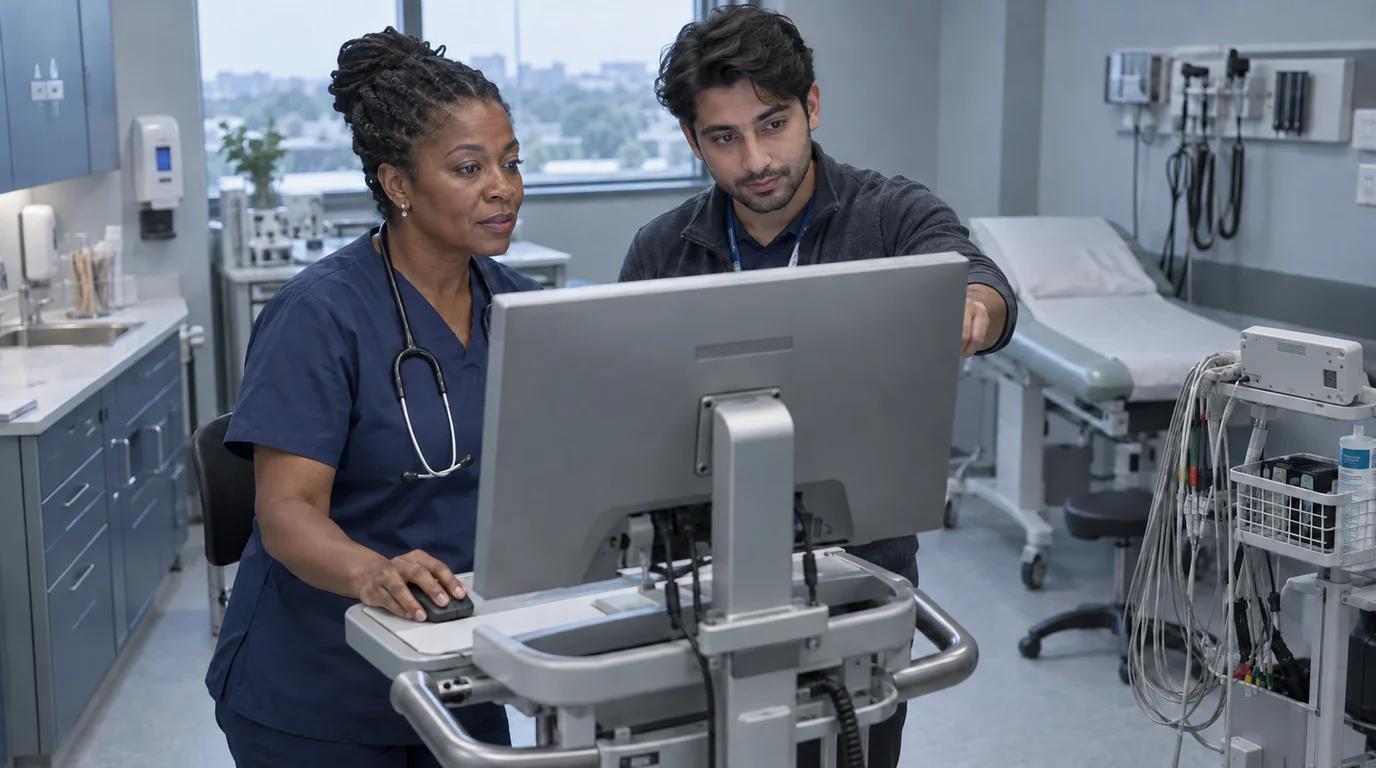
Confirmation Takes 80% Less Time
- ECG confirmation took 80% less time with the delivered workflow.
- AI findings, studies and report controls sit in one clinical review path.
- Clinicians review the interpretation and retain the final sign-off.
MyoVista Insights runs today as HeartSciences' core product across multiple healthcare organizations in US and UK production, giving clinicians one view of ECGs, AI results, and prior studies inside their own EHR, plus natural-language search over the clinical worklist.
One Reading, Whichever Device Made It
A DICOM file arrives from one device manufacturer with the ECG amplitudes encoded in microvolts. A second file, equally compliant, arrives from another manufacturer carrying the same physical signal in millivolts. Neither file is malformed, so nothing throws and no alarm fires. Absorb that difference in the ingestion layer and the platform is genuinely vendor-neutral; miss it and the platform hands a cardiologist a number that is wrong by three orders of magnitude and looks entirely right.
Vendor neutrality is a claim about the parsing layer, not the marketing page. The DICOM Supplement 30 Waveform Interchange specification (NEMA) deliberately leaves room for vendor-specific encoding choices, so two fully compliant files can describe the same heartbeat with different scalar units, different lead labels, and different acquisition templates. The failure modes are that concrete: lead-order permutations that silently swap V1 and V4, and amplitude scaling in microvolts on one device and millivolts on another.
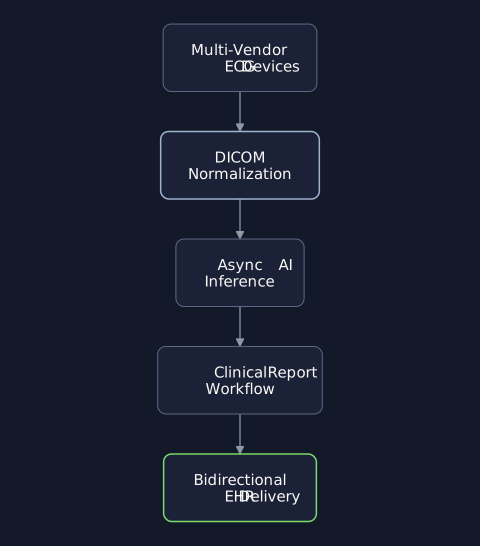
The normalization layer that ML LABS built extracts waveform data and clinical measurements from each vendor's DICOM dialect into one unified representation, then checks the result against expected physiological ranges before AI inference is allowed to run. Duplicate submissions are recognized by waveform fingerprint, so a clinic that uploads the same study through two pathways does not pay twice or read two answers.
Every device vendor encodes clinical data differently. Getting this wrong does not produce an error message. It produces a clinically incorrect value that looks right. The platform that handles this correctly becomes the one clinicians trust.
Records Reach A Known End State
The AI layer runs studies through multiple model providers. ML LABS built an async inference architecture that decouples ECG submission from AI result delivery, absorbs provider unavailability without dropping work, and supports per-organization model enablement so an algorithm can be rolled out to one organization before the rest. Adding a new AI model provider is a configuration task rather than an engineering project.
Each inference request carries an idempotency key, so a retry after a provider timeout can never produce a second billable result for the same ECG. Every record reaches a definite terminal state that a query can name, so reconciliation is a query, not a heroic act. HeartSciences' study volumes, inference latencies, and production availability are the client's own data, and ML LABS will not publish them to make a case study look better.
Results Land In The Clinician's EHR
EHR integration means participating in the clinical order workflow, not merely reading patient demographics out of it. The platform receives an order message when a physician requests an ECG interpretation, processes the study through inference, and returns a result message carrying clinical measurements and the billing codes downstream hospital systems depend on for reimbursement. A malformed result message is not a logging problem; it is an unpaid claim and a clinician who never learns the answer came back.
Clinical reports are signed, confirmed, and locked through a lifecycle carrying legal and regulatory weight, so the report workflow enforces accountability at each stage and tracks every post-signature modification with a full audit trail. Security was remediated inside the delivery cadence rather than deferred to a hardening phase at the end.
New Hospitals Join Without New Code
The most consequential decision on this platform was made before it had a second customer: onboarding a new organization is configuration, never code. A new organization is defined by its HL7 field mappings, its enabled AI models, its invoice pricing, and its storage provisioning, and each is a configuration surface rather than a branch in the codebase.
HeartSciences adds hospitals, device vendors, and AI model providers by configuring them, not by commissioning engineering projects, and the same codebase serves test, US production, and UK production with data residency separation built into the infrastructure.
Omar did outstanding work designing and building the backend for our cloud-native AI-ECG platform. I recommend him to any organization needing a skilled and reliable engineering partner.
— Jason Domask, Director of Software Engineering, HeartSciences
HeartSciences remains an ML LABS engineering retainer client. The retainer's work includes the clinical billing automation system and the multi-site clinical operations automation.
Flexibility Paid For Only Where Needed
Configuration-first multi-tenancy is front-loaded, and front-loaded cost is real cost. In a domain with one device vendor, one model, one jurisdiction, and one billing scheme, it is a tax on variability that will never arrive, and the honest recommendation is to skip it. The test is not ambition, it is the count of open axes: each dimension that can plausibly gain a second value is a configuration surface you will otherwise discover as a migration.
Two Steps That Prevent A Migration
- Enumerate the open axes before the schema. List every dimension that can plausibly take a second value (device vendor, model provider, jurisdiction, billing scheme) and decide, on paper, which become configuration surfaces and which stay hard-coded.
- Write the terminal-state list before the happy path. Name every end state a record may reach, and make each one queryable. If an engineer cannot answer "where is study X and why" with one query, an operator is already paying the reconciliation burden.
Seams Designed Early Stay Cheap
On this platform the hard part was never the model; it was the seams: vendor formats, model providers, EHR dialects, and a second country's residency rules. Seams are cheap to design and expensive to retrofit. When crossing systems is the hard part of what you are building, that is the build, and the person who built it keeps it running.
References
- NEMA. DICOM Supplement 30: Waveform Interchange. DICOM Standard, 2024.