An email arrives from a supplier you have paid for six years. Their bank has changed, a letter on their letterhead is attached, and the next invoice, $186k, is due Friday. Your payables clerk updates the supplier's record, the payment runs, and three weeks later the real supplier calls to ask where their money is. The email came from a domain one letter off theirs, or from their own mailbox after someone took it over. Your money left by wire or ACH, and it now sits in an account the supplier does not control, and the real supplier may still demand payment.

Why this request works on you
Nothing in the request looks wrong to your team. Suppliers do change banks, merge, and move their treasury to a new provider, so your payables team handles genuine changes most weeks. The fraudulent one uses the same words, the same letterhead and often the same email thread as the genuine ones. Your controls see an ordinary update to a supplier record, and your payment run treats it as approved, like every genuine change before it.
The figures behind the request
The FBI's 2025 Internet Crime Report, published in 2026, counts 24,768 complaints of business email compromise, with losses of about $3.0B, up from $2.8B the year before. Divided by complaints, that is about $123k for each. Among the cyber-enabled fraud types the report ranks by loss, only investment fraud cost more. The report defines the scam as one targeting those "working with suppliers" or regularly paying by wire transfer.
In the 2026 survey from the Association for Financial Professionals, 74% of organizations were affected by business email compromise in 2025. Among organizations with revenue under $1B, 48% reported a financial loss from payments fraud. The same survey a year earlier found that impersonating a third party was the most frequent type of business email compromise, at 63%; vendor imposter fraud was cited by 45%, up 11 points.
Why most flags are false alarms
Your company has 1,500 active suppliers and processes about 120 bank detail changes a year. One of them is fraudulent. Your team flags a request that shows any of three signs: a new country or bank, a change just before a large invoice, or a sender domain one character off. A flag appears on 90% of fraudulent requests and on 10% of genuine ones.
Bayes' rule says how much a flag should move your belief, and it depends on the base rate: how rare fraud is before you see any sign. Here, 120 changes a year produce about 13 flags, almost all of them on the 119 genuine changes; the one fraudulent request is flagged 9 times in 10. So a flag is fraudulent about 7% of the time, roughly once in 14.
Your reviewer chases a flag, calls the supplier, and finds a real change, a dozen times a year. After a year of false alarms, the call feels optional, and a check that depends on someone deciding to make it can be skipped on a busy Friday. A rule your system enforces on every change removes that decision: new details cannot pay until a callback is recorded.
The rule that does the work
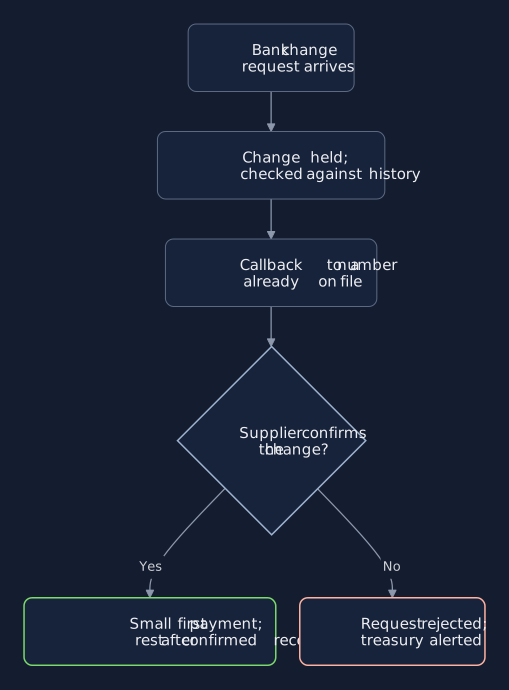
Build the rule into the supplier master record, so no bank change takes effect by an edit:
- Every change is held. New details sit pending; no payment can use them yet.
- A callback confirms it. Someone calls a number already on file, never one in the request.
- The first payment is split. A small part pays; the rest waits for confirmed receipt.
If the supplier does not confirm the change, the request is rejected and treasury is alerted the same day. The number on file has its own guard: a change to a supplier's contacts is verified the same way, and never in the same request that changes the bank details.
The supplier confirms that the small part arrived, again through the number on file. A transfer that lands proves only that the account exists, not that the supplier controls it.
The callback costs about 15 minutes per change, or 30 hours a year at 120 changes, plus building the hold into your finance system and the days a split payment adds until receipt is confirmed. Set that against what one stopped request protects: the FBI figures average about $123k per complaint, and the $186k invoice above is larger. Your reviewers keep their judgment for the exceptions the rule raises, such as a supplier you cannot reach.
What the history check reads
The callback answers whether the supplier made the change. A comparison with history decides which held changes get more than the callback, using three signals:
- A change shortly before a large payment, the timing that pays the fraudster most.
- A sender domain one character off the supplier's domain recorded on file.
- A new country or a new bank for a supplier paid the same way for years.
A change that shows one of these gets added steps: the callback made by treasury rather than the clerk, a second approver, and a longer hold on the first payment to the new account. The comparison adds steps and orders the queue; it never removes a step.
Where AI helps, and its limit
The 2026 treasury survey found that just 17% of organizations use AI against payments fraud. A model can read the emails and attachments in the inboxes you connect, find the ones that ask for new bank details, match each to a supplier record, and send the uncertain matches to a person. It can compare sender domains, invoice timing and bank country against history, and score the request so the riskiest ones reach your reviewer first.
The FBI warns that chat generators write official-sounding emails, so a well-written request proves nothing. Your finance system holds every change until the callback, whatever the model's score, whoever enters it and however urgent the email sounds.
Three steps to take first
- Pull last year's bank detail changes. Note how each one was confirmed.
- Find where callback numbers come from. Your file, or the request?
- Test one change end to end. Can new details pay at once in your system?
Bring your change path to a call
A fifteen-minute call traces how a bank detail change moves today, from the inbox where it lands to the payment run that uses it, and names the step to check first. If your hold and callback cover every change, you hear that plainly and keep the control as it is.
Where the change path runs through your finance system and inboxes, Engineering builds the hold, the history checks and the scoring with your team, so your people own the control.
References
- Federal Bureau of Investigation, Internet Crime Complaint Center, 2025 Internet Crime Report. IC3, published 2026-04-07.
- Association for Financial Professionals. Over 75% of US Firms Experienced Payments Fraud in 2025, While AI Adoption for Fraud Mitigation Lags. AFP, published 2026-04-14.
- Association for Financial Professionals. Survey: 79% of Organizations Were Victims of Attempted or Actual Payments Fraud Activity in 2024. AFP, published 2025-04-15.