You are replacing the system your finance, billing or operations run on, and the plan has one go-live date. On that date every process moves at once: invoicing, payments, payroll, the month-end close. If one of them fails, you learn it with every other process already moved, often with no route back. The least ready process now sets the risk for all of them.

One weekend, every process at risk
Over one weekend in April 2018, a UK bank moved most of its operations, customer services and customer data to a new platform. A 2022 final notice from the Financial Conduct Authority describes what followed: soon after go-live, some customers could not access their accounts, digital and telephone banking failed, and queues built up in busy branches. The bank did not return to business as usual until 10 December 2018. It received 225,492 complaints, paid £32.7M in redress to customers, and was fined £48.65M by its regulators, whose press release says a significant proportion of its 5.2 million customers were affected.
The notice is plain about the design: with the entire customer base moving at essentially the same time, a roll-back to the previous system was not possible. Among the reasons the bank gave for moving in one event, the notice lists the costs of a staged migration.
The council that went live anyway
Birmingham City Council went live with a new finance and HR system on 11 April 2022. A 2025 report in The Register on the external auditor's findings describes staff who could not fully test the bank reconciliation system, because the first step, loading the bank files, was failing; cash management still went to the steering committee rated green. A January 2026 follow-up reported that the council struggled to understand its cash position and could not produce auditable accounts, and gave its forecast of the program's total cost to 2027/28: £144.4M, against an initial estimate of £19M, more than seven times the original figure.
Paying in stages buys options
Economists have a name for what a staged plan buys: real options. Each stage you fund gives you the right, without the obligation, to continue, change course, expand or stop once you see its result. An option is worth more when the outcome is uncertain. The options come from how you commit: budget released in stages, with a written decision after each. The council's testers saw the bank files fail to load, yet the area was rated green and the system went live. A cutover rule set in advance and measured by automated reconciliation leaves no status to rate: the failed test ends one stage, and stopping avoids spending on later stages.
Staging has a cost, which the bank's notice lists among its reasons for one event. In practice, both systems run side by side for longer, a routing layer has to be built, and someone clears the differences each day. Estimate those costs per process, and set a limit in weeks for each: if the differences stop falling by then, reassess the stage rather than extend it. Set them against what one event exposed at the bank: with no way back, its control failings reached a large share of its customers at once, and recovery took nearly eight months.
Move one process at a time
Put a routing layer in front of the old system: a thin service that every request for a process passes through, such as raising an invoice, posting a payment or issuing a credit note. At first it sends everything to the old system. Then, process by process, it sends each request to the new system as well. When a process is proven, it goes to the new system alone; the rest keep running where they are. Over months the old system shrinks until nothing routes to it.
Prove it before each cutover
A distributor with $150M in revenue is moving billing off a fifteen-year-old system and starts with credit notes: about 900 a month, raised by one team, each with a known correct result in the old system. The routing layer sends every credit note to both systems; the new system's output is recorded and compared, never posted. Each night an automated reconciliation job compares the two, line by line: customer, amount, tax rate and ledger account.
The first week shows 41 differences, most of them tax rounding on credit notes with many lines. The team fixes the rounding rule in the new system, and by the third week the weekly count is down to 3. The cutover rule is written before the first comparison: 20 consecutive business days with no unexplained difference, including one month-end close.
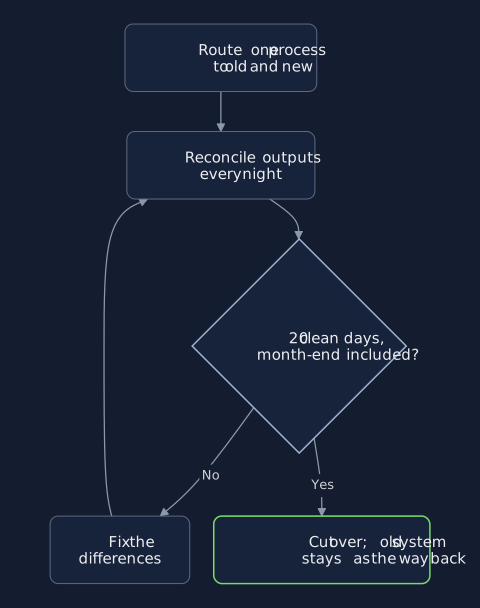
After the cutover, the way back stays open through one more close. Each credit note the new system posts is also written to the old ledger, which sends nothing onward to customers, and the nightly job checks that every write arrived and none was posted twice. Before cutover day, the team rehearses the switch back on test records: clear any outstanding writes, then change one setting in the routing layer and check the balances. About seven weeks after the first comparison, one process has moved and every other process is untouched.
A harness that checks each stage
What makes each stage safe is a harness: automated checks that compare the new system's output with the expected behavior on every change, not only at cutover. For a client in medical technology, we built a simulator of the hospital record system's workflows, so the integration was developed and tested before any sandbox access existed. That simulator then became the regression harness that checks every later change to the integration.
In a migration, keep the cases recorded in each parallel run and replay them whenever someone changes a tax rule, a mapping or an approval limit, long after the old system is gone. A migration run as staged changes also needs its requirements kept current: in TopDo.ai, when a requirement changes, its linked work reopens with the change flagged for you.
Three steps to take first
- List your processes. Each one the system runs, its volume and its owner.
- Pick the first to move. Steady volume, a known result, a contained failure.
- Write the cutover rule. The clean days, the close they include, the way back.
Bring your first process to a call
A fifteen-minute call goes through your process list and names the first process to move and what would prove it before cutover. If a single cutover suits your situation better, because the system is small or the old one cannot run in parallel, you hear that plainly.
Where the migration is core to your business, Engineering builds the routing layer, reconciliation jobs and harness with your team, so your people own them after the last process moves. For an outside review of each go-live decision, Advisory gives you one.
References
- Financial Conduct Authority. Final Notice: TSB Bank plc. Financial Conduct Authority, published 2022-12-20.
- Financial Conduct Authority. TSB fined £48.65m for operational resilience failings. Financial Conduct Authority, published 2022-12-20.
- The Register. How mega city council's failure to act on Oracle rollout crashed its financial controls. The Register, published 2025-02-27.
- The Register. Birmingham City Council's Oracle ERP fiasco now £144M and still not working. The Register, published 2026-01-29.