ARTICLES · DUE DILIGENCE, ON US
Read the guides before you commit.
Decision guides and engineering notes on choosing, scoping, building and running AI systems that keep working in your daily operations, long after the launch.
- Read guides to choosing and building useful AI systems.
- Explore the engineering work behind reliable operation.
- Test a proposal before you commit budget or people to it.
Strategy

You Are Approving A Build Nobody Has Checked
The proposal has a number, a timeline and a team who believe in it. Most AI projects are lost in that room, because nobody independent has checked the decision it changes, the data it runs on, or the systems it must plug into.

Three Tests Before Anyone Starts Building
Readiness is not enthusiasm, and it is not feasibility. It is whether a stranger can grade the target, the systems can be reached today, and one person can change the target tomorrow, all checked before any budget moves.

The Work Your ERP Was Never Built To Do
The enterprise system covers the standard 80% of the work. The delay, cost and eventual control finding sit in the 20% around it, now run on a spreadsheet and a weekly meeting. Build the software around it, not instead of it.

Your Material Weakness Disclosure Is A Software Deadline
A disclosed control weakness is read in the boardroom as a governance sentence. It is also a dated commitment to produce evidence in a volume an auditor can sample, and records at that volume are produced by systems.
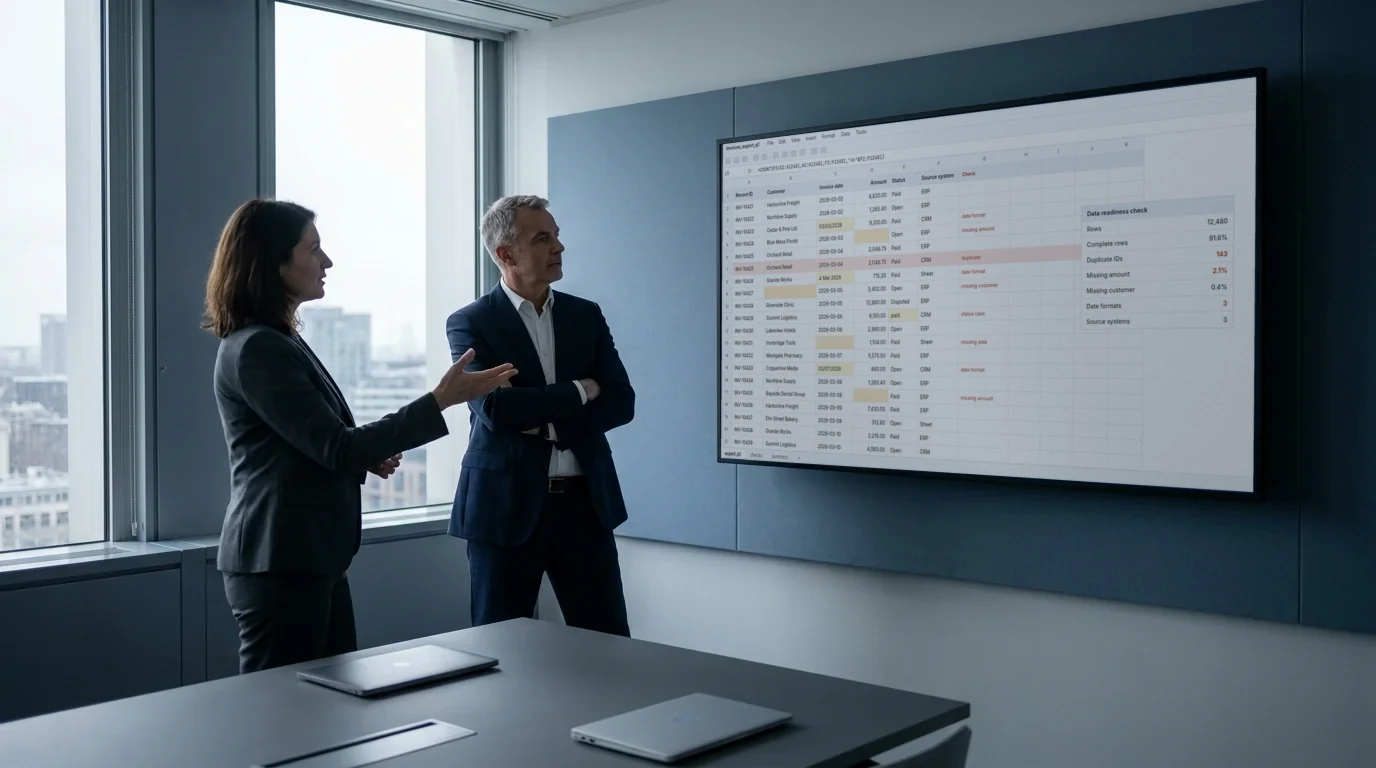
Is Your Data Good Enough To Start Building?
You have a workflow worth fixing and no way to tell whether your data can carry it. Build-ready data is accessible, representative and stable enough for one workflow. This is the lowest bar it has to clear before a real build starts.

A Spreadsheet Is A Control Until Someone Asks
Remediation fails on evidence, not process. The control usually exists and someone really performs it; what is missing is proof that it ran, in order, by the right person, before the period closed. Make the step record itself.

Your Routing Decisions Run On Last Week's Numbers
Nothing looks broken. Your team still produces defensible answers from last week's numbers, and margin leaks out of the routes nobody had the time to re-price. Here is when routing becomes an AI problem, and where to start.

Which Service Workflow Deserves Your First AI Investment
Compare operational consequence, system access and adoption before funding an AI workflow, with the evidence written beside each answer. The most useful first investment solves a problem your team can act on today.

The Control Your Auditor Cannot Re-Perform
A control that is a person's check may run every time and still fail an audit, because nobody can re-perform it. Design the evidence into the system from the start, captured at the moment of each action, with its reasoning attached.

It Went Live And The Savings Never Arrived
The system works and the return still has not shown up in your numbers. Every dollar is committed before launch and every dollar of return is earned after it, once the project budget has closed and nobody owns the system.
AFTER THE READING
Apply the guide to your case.
Bring the decision you are weighing. You leave knowing which parts fit your workflow and what to do first.
Fifteen minutes with Omar.