Your customer contracts promise you a 3% price increase each year, a charge when a customer buys less than its committed volume, and a fee when an invoice is paid late. Your supplier contracts promise you a rebate once your purchases pass a tier. In many companies the billing system holds only the price someone keyed in at signature. It invoices that price until a person changes it, and no report shows the increase that never happened.
Unbilled terms are part of a larger loss. A 2025 whitepaper from World Commerce & Contracting puts the value poor contracting erodes at almost 9% of annual revenue, and often 15% or more in complex industries. It names invoicing errors and missed entitlements among the causes, and it finds contract data spread over 24 systems on average.

A city audit found the pattern
One public audit shows the mechanism in detail. In a 2018 report, the City of Toronto's Auditor General reviewed 45 occupancies of City-owned property and found 22 where additional rents and recoveries were not billed and collected. In the sample, at least $4.5M (Canadian dollars) had gone unbilled for prior periods, in some cases since 2002.
In three of 14 leases with escalation clauses, the required increases were not billed or collected. One occupant paid the same $75,600 annual base rent for almost 12 years because two required rent reviews were not performed. The monthly reports meant to flag upcoming increases were not being generated as the division's own procedures required, and many leases were not set up in the financial system to flag percentage rent due.
Why no report shows the gap
Your controls are built to catch wrong numbers. A duplicate invoice, a price that differs from the price list or a payment that does not match an invoice each leaves a record that a check can compare. A term that is never invoiced leaves nothing to compare. The contract holds a rule; the billing system holds a price, and nobody owns the moment the rule should change the price. The common cases, each a rule your finance systems do not hold:
- Price escalators due on an anniversary, often tied to an index.
- Minimum volume charges when a customer buys less than committed.
- Rebates owed to you once your purchases from a supplier pass a tier.
- Late fees your terms allow and your team never charges.
- Renewal increases written into auto-renewing contracts.
Small misses add up across terms
The formal idea that sizes this problem is expected value: the probability that something happens times what it costs when it does, summed across every case. For your contracts, each term carries a small chance of being missed and a modest amount at stake. No single term looks worth a review; summed across hundreds of contracts, the total is.
A $120M company with 300 customer contracts averaging $250k a year, each with a 3% annual escalator, shows why. The audit found three of 14 escalators unbilled. At half that rate, one missed in ten, each miss costs $7,500 a year, and the expected loss is 300 times 0.10 times $7,500, or $225k a year. Sixty of those contracts also set a minimum volume. If one customer in five falls short each year, with an average shortfall charge of $20k, and half of those charges go unbilled, that is another $120k. That is $345k a year from two kinds of term alone, and every missed escalator repeats each later year until someone notices.
Expected value tells you where to look first: the contract families (contracts written on one template) with the most terms, the largest amounts and the least review.
Turn every term into a record
The fix is to make each billable term data your systems can check. A model reads each signed contract and writes every billable term into structured fields: the term, its trigger, the amount or rate, the effective date, and the source clause with its page. A person on your finance team checks each extraction once against the clause before it counts. After that check, the record is trusted, and nobody on your team rereads the contract at each month end.
Amendments are where these records go stale. When a contract is amended, the amendment goes through the same extraction and the same check, and the fields for that contract are updated before the next monthly run, so the job never compares against old terms.
Compare owed against invoiced
Each month, a reconciliation job computes what each contract says you should have billed, from the term fields and the volumes in your ERP, and compares it with what you actually invoiced. The same job reads payment dates for late fees and published index values for indexed escalators, and it compares your purchases against each supplier's rebate tiers and the credits you received. A match needs no one. A gap goes to a queue owned by the person who manages that customer or supplier, with the amount and the clause attached.
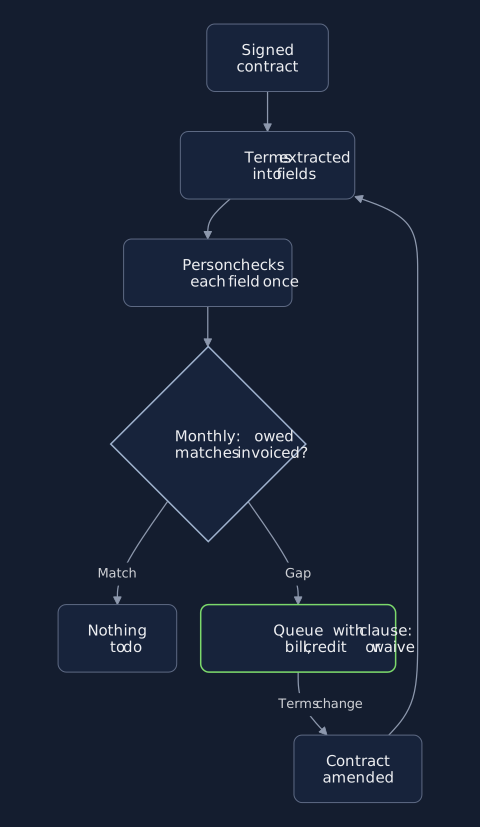
A queue item reads like this: clause 7.2, page 14, a 3% increase due on July 1; invoiced at the old rate from July to September; gap $1,875. The owner bills, credits or waives it with a reason. Record each waiver too, because a term you choose not to enforce is a decision your next renewal should see. A resolution that changes the terms goes back through extraction.
Agreement terms as running data
The principle underneath is that agreement terms become data a system uses on every run, instead of text people reread only when a renewal comes up. For a client in telecom, a top-10 global operator, we built a platform that optimizes roaming cost and routing together from agreement terms, live network telemetry and historical traffic, so the terms feed every routing recommendation. It surfaced optimization opportunities across 128% more routes between countries than originally scoped, which the manual analysis had never reached.
Three steps to take first
- Pick one contract family. One with escalators, on your most used template.
- List each billable term. In a sheet: its trigger, amount and clause.
- Compare twelve months of invoices. Set them against what each term required.
Bring one family to a call
In a fifteen-minute call you describe one contract family and leave with the terms most likely to be going unbilled and the records to pull to size them. If your billing already matches your contracts, you hear that plainly, and you keep your process as it is.
Where the reconciliation should run every month, Engineering builds the extraction, the check and the gap queue with your finance team, so your people own the records and the queue.
References
- World Commerce & Contracting. Contract Management: An Overlooked Driver of Business Agility and Financial Performance. World Commerce & Contracting, published 2025-08.
- City of Toronto Auditor General. Enhance Focus on Lease Administration of City-owned Properties. City of Toronto, published 2018-06-28.