Your revenue grew 8% last year. Your cloud and data bill grew 30%. When you ask which product, customer or report drove the difference, the answer is a list of services with technical names and no owner beside any of them. The bill arrives as one number, finance books it as one line, and nobody in the company is accountable for whether it is worth paying.
A 2026 survey from the FinOps Foundation covered 1,192 respondents and over $83bn in annual cloud spend. It found "workload optimization and waste reduction remain the single top current priority" for cost teams. A 2026 survey by a cloud-cost software provider, of over 750 cloud decision-makers and users, found respondents' wasted cloud spend rose to 29%, the first increase in five years, and 85% name managing cloud spend a top challenge.

Why the bill outgrows revenue
Revenue grows with orders and customers; a cloud bill grows with all your systems keep and process, used or not. Three common habits widen the gap, and none raises an error:
- Data kept forever. Logs stay on the fastest storage with no retirement rule.
- Data stored twice. One order history sits in the warehouse and in a copy.
- Work done for nobody. A nightly job rebuilds a report nobody opens.
Each habit adds a monthly charge that runs whether or not sales move, so the bill can rise in a flat quarter, and an even 10% cut soon returns: the copies, logs and jobs still run.
What one more order costs
Two ideas from economics explain it. Unit cost is the bill divided by a unit of your business: cost per order, per customer or per report. Marginal cost is what one more unit adds.
When the bill grows faster than volume, the spend added per added order runs above the average. Serving one more order rarely costs that much; the gap is a variance to explain, and usually where the money is. The same reasoning applies to retention. The marginal cost of keeping one more year of data is not that year's storage once; it is that storage paid every month for as long as you keep it, plus every copy and every backup made of it.
The FinOps Foundation survey lists unit economics among the capabilities of mature practices. A bill per order is its plainest form: it shows whether spend follows the business.
A distributor's bill, traced
A distributor with $140M in revenue processes 70,000 orders a month on a $210k monthly cloud and data bill: $3.00 per order. A year later, orders are up 8% to 75,600, and the bill is up 30% to $273k. Cost per order is now $3.61, up 20%. The bill added about $11 for each of the 5,600 added orders, against a $3.00 average. At the old average, the added orders would account for about $17k; the other $46k of the $63k increase is the variance to explain.
Once resources carry owner tags, the tags tell you whose spend rose; this year's billing lines and usage, against last year's, tell you why. Here the $46k has three causes: a third copy of the order and shipment history, rebuilt in full every hour for a new dashboard ($18k); a new event stream logged to the fastest storage tier with no rule to retire it ($16k); and nightly jobs added for a spring project, still rebuilding reports that no one now reads ($12k).
The same pattern runs deeper than the bill. For a client in investment management, a hedge fund, we corrected the data foundation: the fund was storing duplicated and polluted data, and its aggregation discarded detail that mattered. Storage costs fell by more than 60% and its models performed 2% better. Nothing there had ever raised an error.
Five changes to your systems
Each of these is built once into how your systems record and keep data:
- Tag every resource to an owner and a product. Refuse anything untagged.
- Compute unit cost each month. Join the billing export to order counts.
- Find duplicate and unread data. Access logs show what was read this year.
- Move unread data to lower-cost storage. A retention rule then deletes it.
- Alert when the bill rises faster than volume. Route it to the tag's owner.
Before anything unread is retired, its owner checks what still depends on it. Retention periods are a finance and legal decision, not an engineering default: set them once per kind of data, write them into the storage rules, and the systems apply them every day.
The review that runs monthly
These changes feed one monthly review with your finance lead and the data owners. The tagged bill becomes a unit cost, and the unit cost decides what happens next:
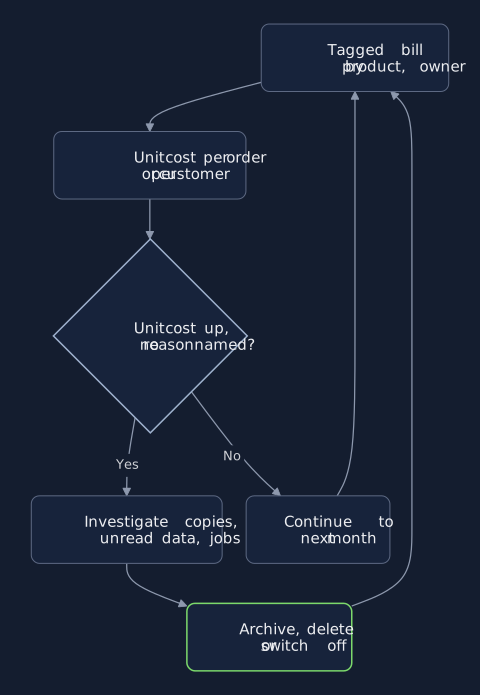
A bill that rises in step with orders is the business growing. A unit cost that rises with no reason anyone can name is a signal to find its cause and its effect on your margin.
When the bill is not the issue
Some increases are worth paying. A new product line, a new market or a model that wins more orders can raise cost per order for a quarter before the added volume arrives. The unit cost shows that too: it rises with a reason you can name, then falls as volume follows.
Three steps to take first
- Pick one unit. Orders, active customers or reports: the one revenue follows.
- Divide last month's bill by it. Do the same for that month last year.
- Name the three largest services. Ask who owns each and who reads its data.
Bring one unit cost to a call
Bring that unit cost for both months and your three largest services to a fifteen-minute call. You leave knowing which billing lines to pull next and whether copies, retention or jobs most likely drive the rise. If your bill already follows your business, you will hear that plainly.
Where the tagging, unit cost report and retention rules need building, Engineering builds them with your team. Once it runs, Advisory answers your cost questions in writing.
References
- FinOps Foundation. State of FinOps 2026 Report. FinOps Foundation, 2026.
- Flexera. Flexera Finds Cloud Value is Rising While AI Waste Grows. Flexera, published 2026-03-18.