Your company pays for AI tools. Marketing has one for content, engineering adopted a coding assistant, support deployed a chatbot, finance is trying something on forecasting, and every one of those lines has an invoice behind it that finance can pull this afternoon. Now ask for the other number: what those tools gave back. If the answer takes several weeks to assemble, or arrives as a set of stories about how much people like using the tools, nobody is managing any of that spend. The spend is only being renewed.
This is the normal condition rather than an exception. An analysis of AI investment returns (Deloitte, 2024) names the paradox directly: 91% of organizations plan to increase AI investment while most take extended periods to reach a return they would call satisfactory. AI spend is rising, the evaluation of it is not, and nothing connects the two.
No AI tool in your stack is failing an evaluation. That is the finding — there is no evaluation to fail, and the renewal happens anyway.
Unowned spend does not announce itself. The sharpest version ML LABS has met was a hedge fund's storage layer, where correcting a data foundation nobody had read cut storage costs by more than 60% and made the fund's models perform 2% better. Nothing had failed. No alert had fired. The bill had been paid, correctly, every month; the full account of what a live system costs when nobody owns it tells that engagement. The mechanism transfers exactly to a tool stack: a line item that nobody reads is a line item that renews.

Adoption And Evaluation Never Meet
The structural cause is a split in ownership, and that split survives good intentions. The person who adopts a tool is choosing at the moment of maximum optimism, against a demo, with a budget that clears without a business case. The person who would evaluate it, if anyone were assigned, works on an annual cycle, sees a line item rather than a workflow, and has no standing to remove something a department says it needs.
A tool that has produced nothing measurable and a tool that has produced a great deal look identical at renewal, because nobody built the instrument that would tell them apart. It is the absence of an owner for one question: is this working, and how would we know?
The Audit That Binds Decisions
An audit that ends in a report changes nothing. This one ends in binding keep, cut, and consolidate decisions, so it needs an owner with authority to execute them before it starts.
Register Every Tool, API, And Model
For each one: monthly cost, active users in the last thirty days, not seats purchased, its business function, and a named owner. The register surfaces duplicate spend: two teams paying for overlapping capabilities is a consolidation decision that needs only visibility.
Define Impact Per Category, Not Per Tool
Measuring a coding assistant and a forecasting model against one metric produces a meaningless number. Each category earns its own definition of impact, and a threshold below which the tool enters the elimination conversation however much users enjoy it.
- Productivity tools: hours returned per user per week, tied to a workflow, not a seat.
- Customer-facing tools: resolution rate, satisfaction delta, conversion, and escalation rate, measured before and after launch rather than in a vendor's benchmark.
- Process automation: throughput, error rate, and time-to-completion on the target workflow, the one the tool was bought for, not the department it sits in.
Decide, Then Consolidate
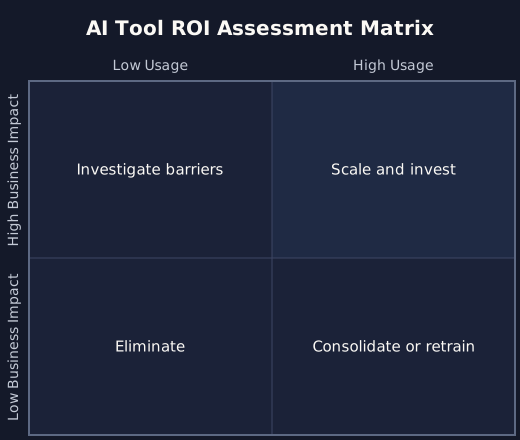
Place every tool in the matrix and act on the quadrant. High impact and high usage earns investment and a pricing negotiation with the vendor. High impact and low usage is a distribution or training problem, not a product problem. Low impact and high usage is popular and not moving anything: consolidate it into another tool. Low impact and low usage gets deactivated, and if nobody protests within one cycle, it is cancelled.
Consolidation is where the largest structural saving sits, and it has a specific rationale. Fewer, better-integrated tools beat more specialized ones not because integration is elegant, but because a workflow inside one system is measurable.

No Owner, No Audit
This framework has one precondition, and it is unforgiving: centralized visibility into the spend, and a named owner per tool. Without the first, the audit stalls at the register: half the stack is invisible, and the half you can see is the half that went through procurement, which is not where the waste concentrates. Without the second, the audit produces findings that nobody has authority to act on, and a finding without authority is a slide.
Assign owners before the audit. A tool nobody agrees to own has already been evaluated.
First Steps
- Give one person the mandate and the billing access. They need to pull spend and usage across every department, including purchases on personal cards that never touched procurement. Without that level of access, the register is fiction.
- Ask the users five questions. Which tools they use, how often, and for what task, what would break if the tool vanished, and what they use instead when it fails. The last two questions are the ones that separate a habit from a dependency.
- Put a decision date on the calendar before you start. An audit with no deadline becomes a permanent workstream, and a permanent workstream is another unowned cost.
Put One Owner On The Spend
Every AI tool maps to a measurable business movement, a named owner, and a decision date, and the spend, the usage, and the impact live in one place somebody reads on a regular schedule rather than at renewal. The waste accumulated not because the tools were bad, but because whether they were working belonged to nobody.
Ownership is a standing job, not a project. Advisory is that job bought as a service: one accountable owner across an AI system we built, and its spend, with cost and drift review as standing agenda items, and a monthly written brief on what ran, what changed, and what is at risk. It runs $10,000 a month, month to month, ending on 30 days' notice either way, and that is the number to hold against the spend the register surfaces. The savings estimate sets that fee against your own hours. If the audit shows the pipeline under the tools was the problem, the data foundation a working AI build needs is where to look next.
References
- Deloitte. AI ROI: The Paradox of Rising Investment and Elusive Returns. Deloitte Insights, 2024.