You hire several hundred people a year: technicians, drivers, nurses. Your applicant tracking system, or a tool beside it, now scores and ranks applicants, and most of them never reach a recruiter. If someone asked you whether that screen advances one group at a lower rate than another, could you show the answer? The law treats that question as yours first.
New York City spelled it out. Local Law 144, enforced since 2023, bars employers from using an automated employment decision tool (AEDT), as defined, unless the tool had a bias audit within one year of its use, information about the audit is public, and candidates got notice. The city's guidance is blunt about who answers for it: the employer is responsible, and the vendor "that created the AEDT is not responsible for a bias audit of the tool."

The duty sits with the employer
The same guidance adds points easy to miss. The audit must be done by an independent auditor, who cannot work for you or the vendor, and it uses historical data from the tool's actual use where enough exists, with demographics never imputed or inferred. Having the audit done settles nothing alone: the city's law requires no specific action on the results, while federal, state and city anti-discrimination laws still apply to what you do with them.
Federal rules agree: the Uniform Guidelines on Employee Selection Procedures expect employers to keep records of their selection procedures' impact, and let agencies infer adverse impact from a failure to keep them, where a group is underrepresented in the job.
What one court let proceed
In May 2025, a federal court in California allowed a nationwide opt-in collective action under the Age Discrimination in Employment Act to proceed against a hiring software provider, on behalf of all applicants aged 40 and older, as a 2025 analysis from Holland & Knight reported. The provider's tools were described as "designed to score, sort, rank or screen applicants," and the court found the claim plausible on a disparate impact theory, which looks at a screen's effect on a group of applicants rather than at anyone's intent.
That ruling was a preliminary step, as the provider stresses, not a finding of discrimination. The claim turns on what the screen did to a group of applicants, and those outcomes sit in your own applicant records: read yours before a regulator or court asks for them.
The four-fifths rule, plainly
The federal guidelines, in place since 1978, give a first test: the four-fifths rule. Take the selection rate of each race, sex or ethnic group at a stage: the share of its applicants who pass. If one group's rate is below 80% of the highest group's rate, the agencies generally treat that as evidence of adverse impact. The ratio of the two rates is the impact ratio. The city's audit requires it across sex, race and ethnicity categories and their intersections. The rule was written for those groups. You can run the same comparison for applicants 40 and older against those under 40; ask your counsel first how age data may be held.
In one month, a field service firm's screen advances 30 of 100 applicants in one group and 4 of 20 in another: 30% against 20%. Its impact ratio is 0.67, well under 0.8.
Small samples need a test too
With 20 applicants in the second group, that gap is weak evidence on its own. If both groups truly passed at the same rate, a gap at least this large would still appear by chance about one month in three (p-value 0.36). The guidelines say as much: large differences on small numbers that are not statistically significant may not constitute adverse impact, and smaller differences that are significant in both statistical and practical terms may.
So the check needs a second number, a significance test, here a two-proportion test. It measures how often a gap at least this large would appear if the rates were truly equal. Over six months at the same rates, 180 of 600 against 24 of 120, the ratio is still 0.67, but a gap this large would now appear by chance less than one time in thirty (p-value 0.026). That is statistically significant at the conventional 5% level: evidence against equal rates.
Log every screening decision
Five changes to your systems make the check possible and the decisions defensible:
- Log each outcome by stage, with the model version and score that produced it.
- Keep voluntary self-identification, collected lawfully and stored apart from the screen.
- Send close calls to a person: rejections near the cutoff are read before they stand.
- Keep the records an audit needs: inputs, scores, versions and the final decision.
- Make the vendor export decision logs in a format your team can read and query.
The last one belongs in the contract, with its format named. A tool that cannot give you its own decisions, by applicant and stage, leaves you unable to answer for them.
Run the check every month
Once the log exists, the check is a monthly job. For each stage the tool touches, by role and model version, it computes selection rates by group over the trailing six months, where lawful self-identified data exists, then the impact ratios and a significance test on each gap, with the sample size shown. It does not replace the audit the city requires where its law applies; with enough reliable data, it lets your team investigate a gap before anyone else does.
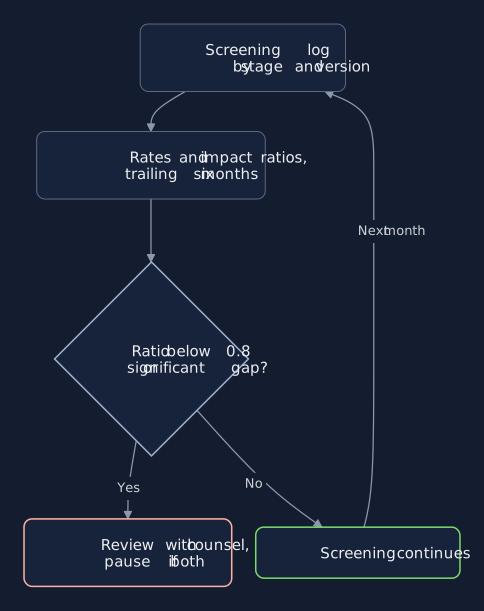
A flagged stage goes to your counsel: which criterion produced the gap, whether it is related to the job, and whether another cutoff or input would serve. A gap that is both below 0.8 and significant, one that would appear under one time in twenty if rates were equal, also pauses the stage until that review is done. That rule is an operating policy to set with counsel, not a statistical safeguard: with many stages and groups tested, some flags will be chance. Because every outcome carries its model version, you can see when a gap appeared and whether a vendor update contributed, beside changes in applicants, roles and criteria.
Bring your screening to a call
A fifteen-minute call goes through where software already screens your applicants, what your systems record today, and whether you could produce selection rates by stage if asked tomorrow. If your records already answer that, the call ends with a clear no.
Where the log, check and review queue must be built into your systems, Engineering builds them with your team, so your people own the check and can show its results to counsel.
References
- New York City Department of Consumer and Worker Protection. Automated Employment Decision Tools (AEDT). NYC.gov.
- New York City Department of Consumer and Worker Protection. Automated Employment Decision Tools: Frequently Asked Questions. NYC.gov.
- Equal Employment Opportunity Commission, Civil Service Commission, Department of Labor and Department of Justice, 29 CFR 1607.4, Information on impact. Electronic Code of Federal Regulations.
- Holland & Knight. Federal Court Allows Collective Action Lawsuit Over Alleged AI Hiring Bias. Holland & Knight Insights, published 2025-05-27.